


International Exhibition for Young Inventors, IEYI-2025
Russia at International Exhibition for Young Inventors 2025
The IEYI-2025 (International Exhibition of Young Inventors) was held at the Wasse Exhibition Center on the grounds of the EXPO-2025 World Exhibition in Osaka, Japan, with participation of schoolchildren from 13 countries.
Russian team of young inventors presented 10 projects.
The international jury of the exhibition included Yuri Kuznetsov, Senior Partner, Head of Patent Practice at Gorodissky&Partners.
The projects were evaluated by the international jury according to 12 criteria, including creativity, functionality, application of the physics laws, market demand, patentability, environmental friendliness, and others.
Gold Medals
|
|
Tikhon Palace (Educational institution "Znayka", Moscow)  |
|
|
|
YONEXBOT During every hour-long training session, several hundred shuttlecocks are used. The robot collects shuttlecocks twelve at a time using a rotating brush. Collected shuttlecocks are stored in an internal container and unloaded via a special mechanism. This saves athletes’ time and enhances training comfort. The casing was created using a 3D printer, and programmed circuit boards ensure control. There are no comparable solutions available on the market, making the project unique. 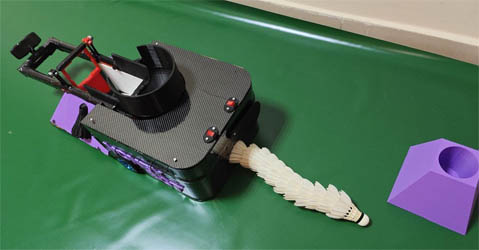 |
|
|
|
Nikita Nazarov (School №354, Moscow)  |
|
|
|
The robot table tennis coach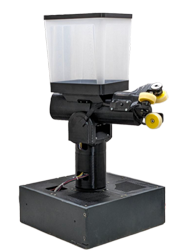 The robot performs various strikes and serves that need to be returned by the athlete, collecting statistics based on which it can adjust the course of the training session. It analyzes the sound of ball impacts against the table, evaluates what areas the user struggles with, and emphasizes those aspects during training. The collected statistics are accessible to players themselves, helping them track their skills, strengths, and weaknesses. The robot performs various strikes and serves that need to be returned by the athlete, collecting statistics based on which it can adjust the course of the training session. It analyzes the sound of ball impacts against the table, evaluates what areas the user struggles with, and emphasizes those aspects during training. The collected statistics are accessible to players themselves, helping them track their skills, strengths, and weaknesses. |
|
|
|
Denis Gordeev (Samara Medical and Technical Lyceum)  |
|
|
|
Algae-based plastic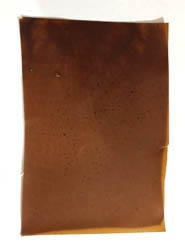 A biodegradable polymer based on zosterin and carrageenan, extracted from the sea grass zostera and red algae of the genus Chondrus crispus, is provided. It can be used as a replacement for food film and plastic, suitable for storing dry food products. After use, for recycling, it is enough to subject the plastic to hydrolysis in boiling water and perform a drying cycle, as a result of which the plastic can be reused more than a dozen times. It does not harm animals and the environment, as it is a mixture of polysaccharides and (in the case of zosterin) methoxylated pectin with glycerin. It has been found that such plastic completely decomposes in the soil to glucose in 2-3 months. The percentage ratio of substances in the polymer can be changed to achieve the required properties of the material. A biodegradable polymer based on zosterin and carrageenan, extracted from the sea grass zostera and red algae of the genus Chondrus crispus, is provided. It can be used as a replacement for food film and plastic, suitable for storing dry food products. After use, for recycling, it is enough to subject the plastic to hydrolysis in boiling water and perform a drying cycle, as a result of which the plastic can be reused more than a dozen times. It does not harm animals and the environment, as it is a mixture of polysaccharides and (in the case of zosterin) methoxylated pectin with glycerin. It has been found that such plastic completely decomposes in the soil to glucose in 2-3 months. The percentage ratio of substances in the polymer can be changed to achieve the required properties of the material.
|
|
Silver Medals
|
|
Ivan Vorontsov, Vadim Fesenko и Victoria Kopysheva (Abrukov's house of scientific collaboration, Cheboksary) 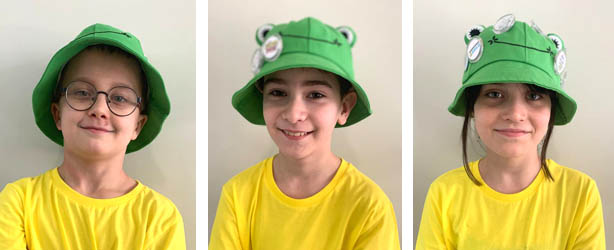 |
|
|
|
Smart “TorfoTrak” autonomous tractor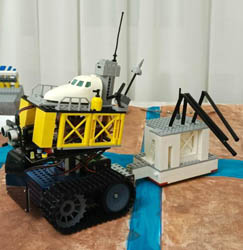 The safe peat extraction system includes the unmanned SMART tractor “TorfoTrak” designed to reduce risks associated with raw material extraction. It utilizes remote control through cameras, radar, lidar, and GNSS systems. Signals regarding obstacles and malfunctions are transmitted to the operator. Tractor attachments are changed automatically thanks to RFID tags. The control center operates according to the digital twin principle. The field being developed is equipped with smoke, temperature, and humidity sensors. The commercial attractiveness of the system lies in increased daily productivity and reduced risks. The safe peat extraction system includes the unmanned SMART tractor “TorfoTrak” designed to reduce risks associated with raw material extraction. It utilizes remote control through cameras, radar, lidar, and GNSS systems. Signals regarding obstacles and malfunctions are transmitted to the operator. Tractor attachments are changed automatically thanks to RFID tags. The control center operates according to the digital twin principle. The field being developed is equipped with smoke, temperature, and humidity sensors. The commercial attractiveness of the system lies in increased daily productivity and reduced risks. |
|
|
|
Oleg Andreychuk (Secondary school №47, Chita) и Тихон Ординат (School "quartal", Moscow) 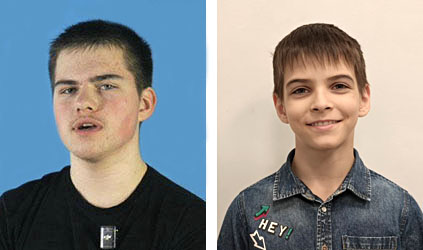 |
|
|
|
Dry Wind - contactless shoe dirt cleaning The device for contactless shoe dirt cleaning is an autonomous module with a two-coordinate nozzle positioning system and built-in sensor. The algorithm dynamically determines the trajectory of the nozzle movement, while pulsed airflow increases cleaning efficiency. The design does not include any contact elements (brushes or rollers), which reduces the risk of damaging shoes. 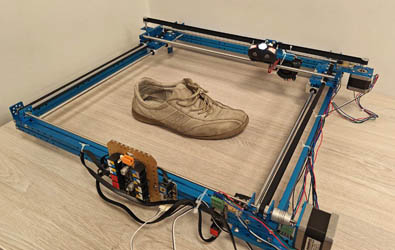 |
|
Bronze Medals
|
|
Nikita Simakov (Technical education center "Vorobyovy gory", Moscow)  |
|
|
|
Autonomous system for monitoring and maintaining climatic paramerters and CO2 concentration in indoor spaces Extended stays in enclosed spaces lead to increased CO2 concentrations, which negatively impact comfort and productivity. The project introduces a system for controlling and maintaining climatic conditions automatically. The device consists of a unit with fans and cyclonic filters, a module for controlling the percentage of carbon dioxide, an automatic fan control module, and a weather station for graphical visualization of climatic parameters. The duct channels are designed to prevent the penetration of outdoor noise and drafts. The components used are affordable and replicable, for instance, in a school workshop. 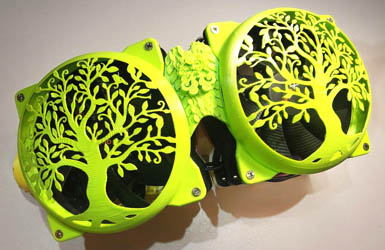 |
|
|
|
Anastasia Suchko (Secondary school №1, Norilsk, Russia) и Alexander Belyaev (School №1554, Moscow, Russia)  |
|
|
|
Feel the Art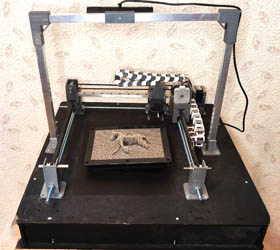 The invention is a 3D display that makes art accessible to people with visual disabilities. The display comprises movable columns creating 3D images. Touching the picture allows feeling its relief and texture. An audioguide provides information on the work's details. A camera tracks the user's hand position, and the YOLOv8 neural network assists in determining the point of contact. This interaction enriches the experience of art perception, making it more accessible and informative. The project enables people with disabilities to enjoy cultural values by opening new opportunities for interacting with works of art. The invention is a 3D display that makes art accessible to people with visual disabilities. The display comprises movable columns creating 3D images. Touching the picture allows feeling its relief and texture. An audioguide provides information on the work's details. A camera tracks the user's hand position, and the YOLOv8 neural network assists in determining the point of contact. This interaction enriches the experience of art perception, making it more accessible and informative. The project enables people with disabilities to enjoy cultural values by opening new opportunities for interacting with works of art. |
|
|
|
Ayusha Gotopov (Aginskaya district gymnasium boarding school, Zabaikalsky Krai, Russia)  |
|
|
|
Cold Engine - Development of a pump for the engine cooling system In this project, a three-dimensional model of a pump has been developed, equipped with additional electric drive, electromagnetic clutches enabling connection/disconnection of the main mechanical drive, as well as a fan. This development makes the cooling system effective regardless of the engine crankshaft speed, ensuring reliable operation under various conditions and operating modes. A similar pump design currently does not exist worldwide. The CAD-developed model allows us to conclude that practical application of the results from this project is feasible. 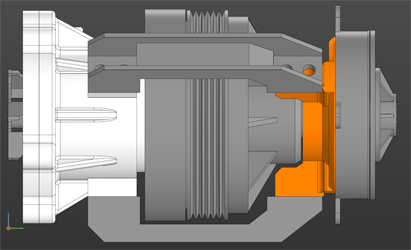 |
|
Special Prizes
|
|
Anna Rodionova (School № 444, Moscow)  |
|
|
|
Coffee blending robot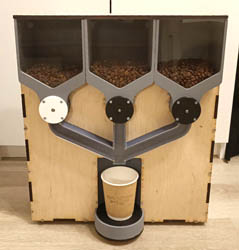 The project focuses on automating the process of creating coffee blends from multiple varieties, eliminating the possibility of blending them in incorrect proportions. This proposed solution speeds up operations in cafes, simplifies baristas' work, and eases staff training processes. Time savings will allow cafés to serve more customers. The system can be assembled with a larger number of compartments for coffee, thus increasing the variety of blend options. The project focuses on automating the process of creating coffee blends from multiple varieties, eliminating the possibility of blending them in incorrect proportions. This proposed solution speeds up operations in cafes, simplifies baristas' work, and eases staff training processes. Time savings will allow cafés to serve more customers. The system can be assembled with a larger number of compartments for coffee, thus increasing the variety of blend options. |
|
|
|
Alexandr Sukhotskii (Technical education center "Vorobyovy gory", Moscow)  |
|
|
|
«SmartSpray»- Precision Plant Spraying System The SmartSpray system represents a mobile platform with automated installation using machine vision for precise foliar and root feeding of cultivated plants and weed spraying, significantly reducing fertilizer consumption and lowering agricultural production costs. Using this method together with pesticides minimizes negative impact on soil microflora and contributes to environmental protection. A neural network trained to identify specific types of plants, along with a tracking system, dynamically monitors each plant, activating the nozzles precisely when the plant is directly beneath them. The next step in developing the project is an autonomous spraying robot with autopilot functionality. 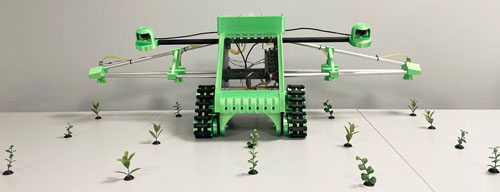 |
|